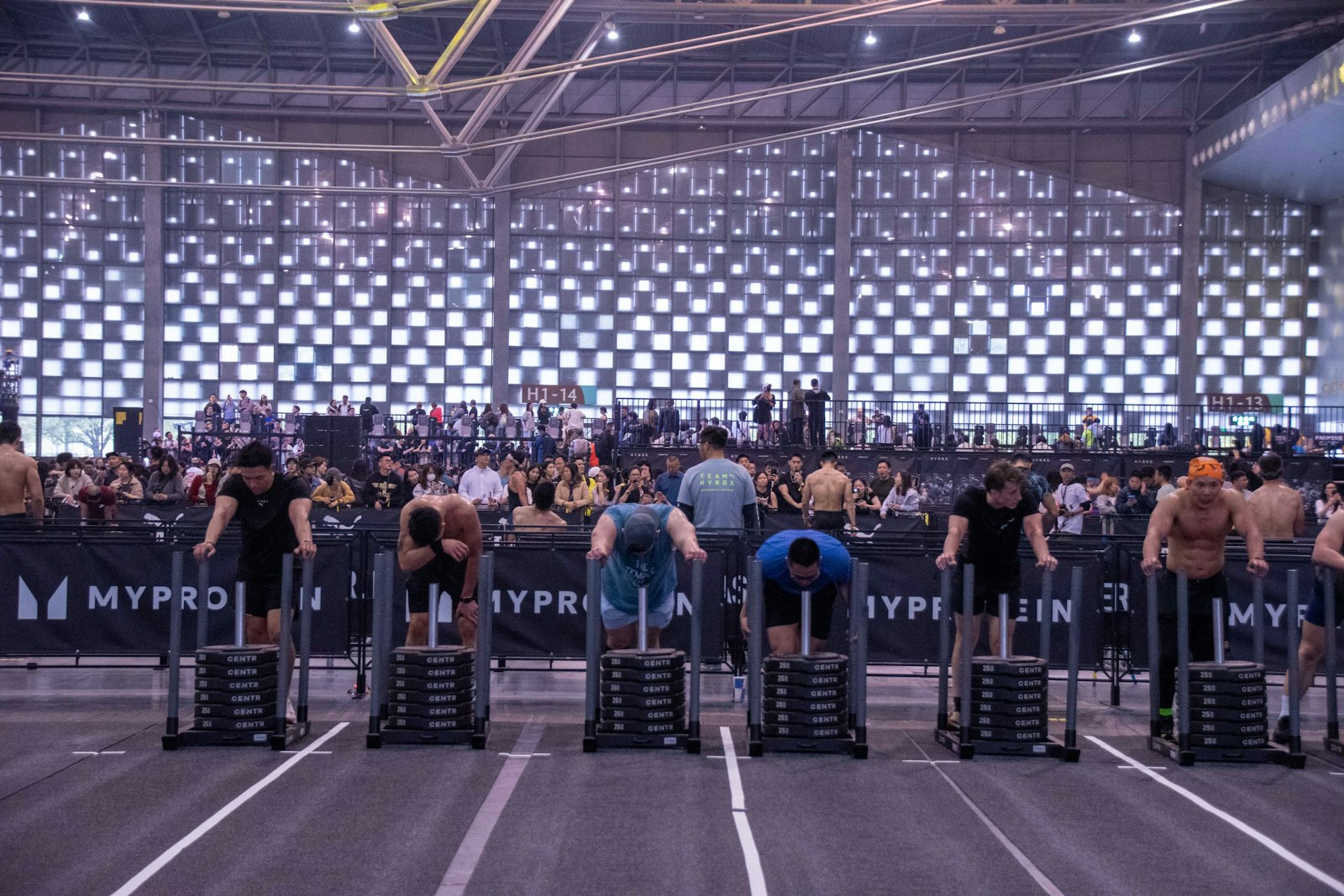
This August, about 12,000 people gathered at Makuhari Messe near Tokyo. Run, push, pull, carry, run again — that's the whole race. And the field ranged from 16 to 76 years old. HYROX. A competition that converts everything you've built in the gym — the lifting, the cardio — into a single number, and it is quietly rewriting how the world trains. What makes people line up for it? Let's take it apart.
Eight 1km runs, with eight stations in between
You run 1km eight times. Between each run, you complete one of eight workout stations: the SkiErg, a sled push, a sled pull, burpee broad jumps, rowing, a farmers carry with weights in each hand, sandbag lunges, and wall balls. The exercises, order, and weights are standardized worldwide, so your time can be compared with any city's. No handstands, no high-skill barbell lifts. A format designed to be finishable, and a yardstick shared by the whole world — those two things are this sport's real invention.
From 570,000 to 1.5 million in two years
HYROX was born in Germany in 2017. Participation grew from about 570,000 worldwide in the 24/25 season to about 1.5 million across 105 races in 25/26. The organizers have announced they expect over 2 million participants across 107 race weekends in the 26/27 season. In Japan, following Yokohama and Osaka (8,087 entrants), "AirAsia HYROX Chiba" was held at Makuhari Messe on August 6–9, 2026, with about 12,000 starters. Domestically, Osaka is set for January 2027 and Nagoya for April 2027.
"Lift and do cardio" was official guidance before it was a trend
Combining strength training with cardio became public-health guidance before it became fashionable. Japan's Ministry of Health, Labour and Welfare, in its Physical Activity and Exercise Guide 2023, recommends that adults do strength training 2–3 days a week, adding that combining it with aerobic activity "can be expected to bring further health benefits." And in 2022, a research team including Tohoku University reported in a meta-analysis that people who do about 30–60 minutes of strength training per week tend to have lower risks of death and major disease. What makes HYROX interesting is that it takes this "do both" advice and turns it from a training-plan intention into a rule of the sport itself.
What gym life was missing was a deadline
From here, this is our editorial read. The longer a gym habit lasts, the blurrier the "what is this for?" becomes. What HYROX provides is a deadline and a single number. The moment a finish time exists as a yardstick, your scattered lifting and running become practice pointed at the same goal. It's the same structure by which city marathons mass-produced "a reason to run" — HYROX created "a day to use the body you built." And people with a goal tend to get more careful about how they rest, too. Work backward from a race, and recovery reveals itself as part of training.
So why now? We see three reasons. First, the maturing of gym culture: the strength-training population kept growing, but the venues for testing that body skewed toward physique contests (appearance) or marathons (cardio), with no middle ground. Second, standardization and social media: a shared global rulebook makes times comparable, and what can be compared gets shared. Third, the speed of the story: it doesn't demand marathon-scale preparation, yet "I finished" still carries real weight. A busy worker can acquire an athlete's story in a few months — it's a sport that seems designed for hard workers with no time.
What you can steal without ever entering
Even if you never sign up, you can steal the design philosophy this week.
- Make one day a week where you don't separate lifting and running. Put a little of both into the same session
- Try running on heavy legs, in small doses. After squats, run just 500m to 1km. The core of HYROX lives in that sensation
- Set your own "finish time." For example, the combined time of a 1km run plus 50 bodyweight squats. Once a number exists, daily training and recovery both gain meaning
Start at a gentle intensity in every case. If you have any health concerns, don't push it — consult a doctor if needed.
Sources
- AirAsia HYROX Chiba event report (Hybrid Fitness Racing HK / PR TIMES, August 2026)
- FITNESS LOVE, "HYROX event schedule and how to enter" (Osaka January 2027, Nagoya April 2027)
- BOXROX, "HYROX Expands Global 2026/27 Season" (participation figures, organizer announcements)
- Japan's Ministry of Health, Labour and Welfare, Physical Activity and Exercise Guide 2023, strength training information sheet (e-Health Net)
- QLifePro, "30–60 minutes of weekly strength training linked to lower risk of death and disease, meta-analysis by Tohoku University and others" (March 2022)